what happened to the populations of the other animals?
After a burn down and explosion destroyed the Chernobyl Nuclear Power Constitute in 1986, more than 100,000 people were permanently evacuated from the area to avoid radiation levels that were twenty times greater than the Hiroshima and Nagasaki bombings. But what happened to the local wildlife? Co-ordinate to a letter published today in the journal, Electric current Biological science, scientists report that the Chernobyl disaster area is habitation to a rich and varied wildlife customs, indicating that the mere presence of people is more than damaging to wild fauna than is radiation poisoning.
Chernobyl was a disaster for people, but for wildlife? Non so much
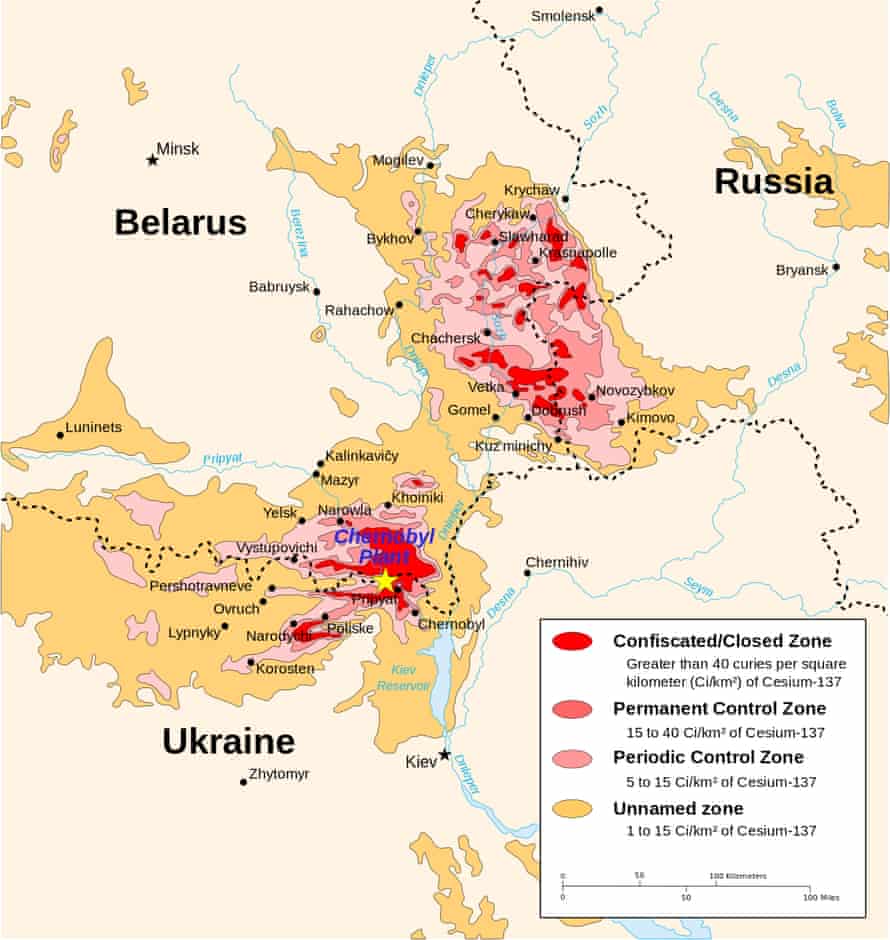
When the Chernobyl nuclear power plant melted down in 1986, more than 116,000 people were permanently relocated from a contaminated area comprising 4200 km2, an area that was afterwards designated the Chernobyl exclusion zone.
Only what happened to the local wild fauna? Previous studies indicate that wildlife numbers initially dropped in the months after the accident (i.e.; doi:x.1098/rsbl.2008.0778). However, thirty years later, what effect is radiations contamination having on the abundance of Chernobyl's large mammals?
An international squad of researchers, headed by Tatiana Deryabina of the Polessye State Radioecological Reserve (PSRER), conducted surveys to notice out. The PSRER is the Belarus sector of the Chernobyl exclusion zone. It covers 2,165 kmii (one-half of the total Chernobyl exclusion expanse) and has similar radiations levels to the Ukrainian sector. The findings for PSRER were compared to four nearby nature reserves that were uncontaminated by the Chernobyl blow: Berezinsky Biosphere Reserve, a state nature reserve covering 852 km2; Braslav Lakes National Park, which covers 645 km2; Belovezhskaya Puscha National Park, a UNESCO World Heritage site situated both in Poland (105 kmii) and Belarus (1501 km2); and Narochansky National Park, which covers 874 km2. Of these, just 2 (Belovezhskaya Puscha and Narochansky National Park) allow limited wildlife hunting.

The team tested three fundamental hypotheses concerning the resilience of wildlife to the world's worst nuclear blow:
To test these hypotheses, trained staff conducted wildlife snow track censuses between 2008 and 2010 along 35 permanent runway survey routes (full combined length of 315 km with an average track length of ix km) (doi:10.1016/j.ecolind.2012.10.025). Specific PSRER habitat types (former agronomical lands, former villages, evergreen forest, and deciduous wood) and levels of radiocæsium contamination density were mapped using GIS along each of these routes.
Aerial surveys were conducted betwixt 1987 and 1997 from February through early March when snowfall cover was present. The study area survey took place from a pinnacle of 100 metres at a speed of lxx-100 km/h and extended to approximately 250 metres on each side of the helicopter.
Every bit you can see, the empirical information show no evidence of long-term radiation damage to the large mammal populations at Chernobyl, and thus, the evidence does non back up whatsoever of the three hypotheses being tested (Figure 1):

In fact, increases in elk (moose) and wild boar populations in the Chernobyl exclusion zone occurred in the early on 1990s, when these species' populations were undergoing a rapid refuse in sometime Soviet Union countries due to increased rural poverty and weakened wildlife direction.
Further, the relative abundance of wolves living in and around the Chernobyl exclusion zone site is more than vii times greater than in the iv nearby uncontaminated nature reserves.

"In that location have long been rumours that the Chernobyl site has abundant wildlife — including carnivores — and so I welcome this piece", said wildlife demographer Tim Coulson, a Professor of Zoology at the Academy of Oxford, who was not part of this study.
"Considering information technology is contaminated land, it is not easy to study wild fauna in detail, and any studies are going to have to rely on approaches like this taken here", said Professor Coulson in email.
In fact, this study demonstrates that, regardless of potential radiations effects on individual animals, the Chernobyl exclusion zone supports a thriving and arable mammal community despite nearly three decades of chronic radiation exposure.
"It'due south very likely that wild fauna numbers at Chernobyl are much college than they were before the accident," said co-author Jim Smith, a Professor of Environmental Science at the University of Portsmouth, in a press release.

Chernobyl's wild boar populations grew especially fast -- until 1993-1994, when they suddenly crashed (Figure 1). This was due to a large increase in wolves, which are particularly fond of dining on wild boar, combined with an outbreak of African swine fever.
Humans are more damaging to wildlife and ecosystems than is radiation poisoning
"This study is a very positive move forwards in conducting research concerning the potential wellness and environmental impacts of nuclear accidents", said population biologist Timothy Mousseau, a Professor in the Biology Section at the University of Due south Carolina, who was not role of this study.
"I applaud the authors in their efforts to bring hard scientific data to bear on the question of impacts to wild fauna in the stricken regions of Ukraine and Belarus. Much more inquiry on this and related questions are desperately needed", said Professor Mousseau in email.
"This doesn't mean radiation is skillful for wildlife, just that the furnishings of human habitation, including hunting, farming, and forestry, are a lot worse," said Professor Smith.
"This is an extremely sad indictment on how bad people are for wild animals", agreed Professor Coulson. "Once [people] take left an area the wildlife appear to thrive — even if the habitat is laced with radiation."
Although the detrimental effects of radiations on individual animals has been well documented, particularly on Chernobyl's wildlife, its effects on populations isn't so clear.
"This written report does not accost the issue of whether radiation has effects on reproduction, survival, longevity, or general health of the animals surveyed", Professor Mousseau pointed out.
Nonetheless, this report indicates that populations of big mammals in the Chernobyl exclusion zone are doing at least also as those in uncontaminated national parks in the vicinity. But sadly, this report clearly shows that putting a big fence around an surface area to keep people out is beneficial to wild animals, even if the negative effects of radiation contagion on wildlife -- increased mutation rates, cancers and other abnormalities -- may be masked past this advantage.
"Obviously I am not condoning nuclear accidents for the sake of wildlife! Far from it", said Professor Coulson. "But hopefully some good can come from it. Hopefully we will realise that for wildlife and ecosystems to flourish, we must leave them be and terminate interfering."
In curt, this paper suggests that not every nuclear wilderness is a bad thing.

Source:
T.G. Deryabina, South.V. Kuchmel, 50.L. Nagorskaya, T.G. Hinton, J.C. Beasley, A. Lerebours, and J.T. Smith (2015). Long-term demography information reveal arable wild animals populations at Chernobyl, Current Biology, published online on five October 2015 alee of print | doi:10.1016/j.cub.2015.08.017 (OA)
besides cited:
Anders Pape Møller and Timothy A. Mousseau (2009). Reduced abundance of insects and spiders linked to radiation at Chernobyl 20 years after the accident, Biology Messages, 5:356–359 | doi:10.1098/rsbl.2008.0778 (OA)
Anders Pape Møller and Timothy A. Mousseau (2013). Assessing furnishings of radiation on abundance of mammals and predator–prey interactions in Chernobyl using tracks in the snow, Ecological Indicators, 26:112–116 | doi:10.1016/j.ecolind.2012.10.025 (costless)
.. .. .. .. .. .. .. .. .. .. ..
GrrlScientist is very active on twitter @GrrlScientist
Source: https://www.theguardian.com/science/grrlscientist/2015/oct/05/what-happened-to-wildlife-when-chernobyl-drove-humans-out-it-thrived
0 Response to "what happened to the populations of the other animals?"
Post a Comment